The consulting club conducted its first major event today. It was a panel discussion on a Consultant’s work profile and culture across different consulting firms. The discussion was moderated by our Deputy Dean Ajit Rangnekar.
Three Alums: Bejoy Suri from Accenture, Anshuman Biyani from BCG and Rohit Kapoor from Mckinsey took part in the discussion.
Most of the discussion was centered around the kind of work consultants do in general with focus on strategy firms. What is consulting? What kind of work the consulting firms do? How is a typical day in a consultant’s life? How do you grow and learn in a consulting firm?—All these and many more such questions in the minds of many students looking at consulting careers post ISB were effectively answered.
The alums discussed in detail the kind of projects they have been doing since they joined their respective firms. The spoke at length about their experiences and touched upon the various assignments they have been involved in, to give the students present a deep insight into the life of a consultant. Ajit provided us with his valuable comments and narrated his own experiences as a consultant to add to the discussion and drive home the issues being discussed.
A consultant’s typical day was also discussed and it was emphasized, that though consulting careers give you a great opportunity to constantly learn, innovate and challenge yourself, it’s a tough job at the end of the day and you need to be one up always to succeed. Further, it was clearly mentioned that consultants had to travel a lot and keep away from their base offices for long periods adding to the challenges of the job.
Later an interactive session with alums was conducted to build upon the discussions and answer certain unanswered questions in detail.
The consulting club would like to thank Bejoy, Anshuman and Rohit for taking time out to be with us. We also thank Ajit for agreeing to moderate the discussion and provide us valuable insights on consulting careers.
-v
Sunday, July 30, 2006

Thursday, July 20, 2006
Falling Rupee--Good News !!
The Indian rupee continues its upward march against the dollar and there was no intervention from the RBI till yesterday. According to a TOI article published yesterday, although the rupee/dollar real exchange rate continues to be strong, a worldwide strengthening of the dollar has lead to a weaker rupee.
The strengthening of the dollar against the rupee is being considered as good news for the Indian business having huge receivables in dollars ( in particular the software firms--) a weaker rupee means more rupee for each dollar receivable and this could lead to boosting up of bottom line for many of the firms.
The RBI believes that as long as the rupee/ dollar real exchange rate is in good shape i.e to say that macroeconomic fundamentals are strong enough a weaker rupee only means good news for Indian firms in the short run. Though, what percentage fall is not a risk to the currency is something to think about
Venkat
The strengthening of the dollar against the rupee is being considered as good news for the Indian business having huge receivables in dollars ( in particular the software firms--) a weaker rupee means more rupee for each dollar receivable and this could lead to boosting up of bottom line for many of the firms.
The RBI believes that as long as the rupee/ dollar real exchange rate is in good shape i.e to say that macroeconomic fundamentals are strong enough a weaker rupee only means good news for Indian firms in the short run. Though, what percentage fall is not a risk to the currency is something to think about
Venkat
Sunday, July 09, 2006
Class of 2007 takes over
The activities of the consulting club were kick started with the formation of the club and election of office bearers. The class of 2007 has diverse set of individuals with their unique strengths and a stellar set of achievements. The profile and expertise of students is reflected in the consulting club as well.
For details about class of 2007 please click here.
The consulting club at the ISB is driven by the following objectives:
- To equip the students with the tools and resources necessary for careers in the consulting domain.
- To create a forum for information exchange among the industry and students.
Following is a snapshot data about the student members of the club:
Number of members: More than 250
Average work experience: 4.5 years
Areas of prior consulting experience:
Management consulting, risk advisory, process / operations consulting, IT consulting, benchmarking advisory.
Club members with consulting experience have previously worked at: (Illustrative only)
KPMG, Ernst & Young, PriceWaterhouse Coopers, Deloitte
Consulting, Ma Foi Management Consultants, Best Practices LLC, IBM, A.F. Ferguson
Club members with domain expertise have previously worked at: (Illustrative Only)
Infosys, TCS, Tata Motors, ICICI Bank, Maruti Udyog, CNBC, Siemens, NCDEX,
Wipro, Microsoft, Progeon, Marico, Evalueserve.com, Thomson Financial
The range of activities planned by the club in the current year includes:
- Facilitating forums such as internal speaker series, knowledge sharing sessions, and industry focus groups ensure the dissemination of knowledge amongst the students.
- The club plans to organise various speaker series’, interactions and workshops with executives from various companies and industries. This would facilitate an environment for knowledge sharing and growth. Interactions with the industry shall widen the students’ knowledge base and enhance their ability to respond to “real world” situations.
- The club plans to organize a plethora of events that prepare students for a career in consulting. These include facilitation of focus groups for case study discussions, groups for discussing the latest trends in industries, conducting mock interviews and regular interactions with consulting firms.
We at the consulting club would like to thank all alumni for all the support rendered to us so far and hope to having many more interactive sessions in the future.
A special thanks to Yashraj ( Class of 2006) for helping us reactivate this blog. This blog would contain updates about the activities of the club and all other material relevant to the Consulting world, Industry insights and preparation for Management Consulting careers.
Any further queries about the club may be addressed to the Club President Akshit Shah at Akshit_Shah@pgp2007.isb.edu
Friday, April 07, 2006
[Consulting@ISB] Big Ticket Dreams - Time to Pause
Dear All,
Now that the placement report has been formally announced, I can formally take a "pause" on this blog. This year has been a watershed year in terms of the consulting placements. New records have been established and our efforts have borne fruits. ISB has bagged huge (if not the largest) number of consulting offers from the bluest of the bluechip firms.
I hope that this blog has served its purpose of being a platform for sharing knowledge with all consulting aspirants from Co2006. We worked as a team to ensure that everyone gets the best shot at their dream consults. There was unprecedented collaboration within the batch and I strongly feel that it helped all of us push our bar a notch higher. Great show! This has only vindicated our belief that consulting placements are not a zero sum game.
The placement figures are available for all to see [ http://www.isb.edu/campussbuzz1/placements_2006_Fact_Sheet.pdf ] so I would not repeat them here.
The incoming batch can use this blog to get a feel of the way their alums went about preparing for consults. From here on it’s up to the Class of 2007 to carry the tradition forward and keep the ISB and Consulting@ISB flag flying high!
Wish you all the best in your careers.
Cheers :)
Yash
ps: if anyone wants to get in touch with me then mail me at yashraj_erande@pgp2006.isb.edu or yashraj.erande@gmail.com or check the alumi website for my latest contact details.
Now that the placement report has been formally announced, I can formally take a "pause" on this blog. This year has been a watershed year in terms of the consulting placements. New records have been established and our efforts have borne fruits. ISB has bagged huge (if not the largest) number of consulting offers from the bluest of the bluechip firms.
I hope that this blog has served its purpose of being a platform for sharing knowledge with all consulting aspirants from Co2006. We worked as a team to ensure that everyone gets the best shot at their dream consults. There was unprecedented collaboration within the batch and I strongly feel that it helped all of us push our bar a notch higher. Great show! This has only vindicated our belief that consulting placements are not a zero sum game.
The placement figures are available for all to see [ http://www.isb.edu/campussbuzz1/placements_2006_Fact_Sheet.pdf ] so I would not repeat them here.
The incoming batch can use this blog to get a feel of the way their alums went about preparing for consults. From here on it’s up to the Class of 2007 to carry the tradition forward and keep the ISB and Consulting@ISB flag flying high!
Wish you all the best in your careers.
Cheers :)
Yash
ps: if anyone wants to get in touch with me then mail me at yashraj_erande@pgp2006.isb.edu or yashraj.erande@gmail.com or check the alumi website for my latest contact details.
Sunday, February 05, 2006
So what ?
Folks:
The following post is courtesy Rohit Kapoor... thanks dude.
Rohit has suggested two very useful frameworks which can be used during PI to generate the 'wow' ;D factor. Read on...
[Rohit's comments --]
I was reflecting on the PI rounds that I conducted and somehow found that the 'wow' factor was missing. The common link was that I could not understand the "so what?" of the answers. In other words the question which came to my mind was "so what is great about this particular thing". I think the challenge-action-impact framework will help in answeing PI questions especially around leadership, team work etc.
Challenge - Describe succintly what were the circumstances which made the job/experience difficult. This gets the interviewers attention.
Action - This part is essentially "what did you do?". This allows the interviewer to appreciate your problem solving and leadership capabilities.
Impact - Anything one does is meaningless unless it impacts something - client, internal processes, colleagues, team etc. Describing the impact tells the interviewer that you are an achiever. Also use a FROM-TO approach within this section. E.g. "The market share in this product category went up from 42 to 45% as a result of these initiatives".
Some other observations:
Please avoid using bombastic terminology like "passion for excellence", "amazing leadership capabilities !!" in describing yourself. You are really setting yourself up for trouble because after you have used such extreme superlatives, your examples better be damn good. Words like "committed", "person who can take end-to-end responsibility" are more likely to be believed and examples can back these up.
Lastly, please please do not give cop-out answers on "What are your weaknesses" question. Answers which are complete disasters are "I work so hard ... I multi-task so much that I fail to prioritize ..... I dont know how to strike work-life balance ..... I am too analytical". The interviewer is out to recruit a human being and not god !! One good answer which I got was "I am a slow starter ..this can be a handicap in consulting .. however I was given this feedback in my last job .... this is what I have done to get better at this"
The following post is courtesy Rohit Kapoor... thanks dude.
Rohit has suggested two very useful frameworks which can be used during PI to generate the 'wow' ;D factor. Read on...
[Rohit's comments --]
I was reflecting on the PI rounds that I conducted and somehow found that the 'wow' factor was missing. The common link was that I could not understand the "so what?" of the answers. In other words the question which came to my mind was "so what is great about this particular thing". I think the challenge-action-impact framework will help in answeing PI questions especially around leadership, team work etc.
Challenge - Describe succintly what were the circumstances which made the job/experience difficult. This gets the interviewers attention.
Action - This part is essentially "what did you do?". This allows the interviewer to appreciate your problem solving and leadership capabilities.
Impact - Anything one does is meaningless unless it impacts something - client, internal processes, colleagues, team etc. Describing the impact tells the interviewer that you are an achiever. Also use a FROM-TO approach within this section. E.g. "The market share in this product category went up from 42 to 45% as a result of these initiatives".
Some other observations:
Please avoid using bombastic terminology like "passion for excellence", "amazing leadership capabilities !!" in describing yourself. You are really setting yourself up for trouble because after you have used such extreme superlatives, your examples better be damn good. Words like "committed", "person who can take end-to-end responsibility" are more likely to be believed and examples can back these up.
Lastly, please please do not give cop-out answers on "What are your weaknesses" question. Answers which are complete disasters are "I work so hard ... I multi-task so much that I fail to prioritize ..... I dont know how to strike work-life balance ..... I am too analytical". The interviewer is out to recruit a human being and not god !! One good answer which I got was "I am a slow starter ..this can be a handicap in consulting .. however I was given this feedback in my last job .... this is what I have done to get better at this"
Saturday, January 28, 2006
Economic Indicators on Economist.com
Some of you might be interested in tracking the Economic indicators on a regular basis.
You can visit this link on Economist.com using ISB login (via E_Resources):
http://www.economist.com/markets/indicators/index_wide.cfm?page=Emerging%20Market&story_id=5446071
-- Yash
You can visit this link on Economist.com using ISB login (via E_Resources):
http://www.economist.com/markets/indicators/index_wide.cfm?page=Emerging%20Market&story_id=5446071
-- Yash
Wednesday, January 18, 2006
Interesting trends in IT industry
As a follow-up after my session on 'Global Delivery Model' here is an excellent article that talks about the emerging dynamics in the Indian IT industry.
It makes a passing reference to a new delivery model christened 'Networked Delivery Model'. In my understanding the key difference between Global and Networked Delivery Model is that the latter may include multiple delivery centers in the same geography operating as a mesh. For example, Chile may provide Insurance (verticle) domain serivces while Mexico may provide Application Development and Maintenance (horizontal) services and India may provide Engineering and QA (horizontal) services.
The main advantages are:
1. Increased localization - European office has better grip over European insurance sector
2. Increased specialization - Chile office focuses mainly on Insurance, India on solution derlivery
3. Increased robustness (risk mitigation) because of increased geographical spread - In built fail over system
In my opinion, in the long run this model will allow TCS to develop processes and competencies at one center (say Solution Delivery capabilities at India) and then roll them out across many other centers (say Latin America). Thus, the main hub will function as a center of excellence in a particular horizontal / verticle.
Although, the article's focus is on TCS' strategies, I think it gives a very good perspective on the changing paradigm in the Indian IT industry. I got this article from an alum - Vijayant Gupta Co 2002. Thanks Vijayant!
file://isbhome/generalhome/Clubs_Co2006/Consulting-Club/Resources/CS.pdf
-- Yash
It makes a passing reference to a new delivery model christened 'Networked Delivery Model'. In my understanding the key difference between Global and Networked Delivery Model is that the latter may include multiple delivery centers in the same geography operating as a mesh. For example, Chile may provide Insurance (verticle) domain serivces while Mexico may provide Application Development and Maintenance (horizontal) services and India may provide Engineering and QA (horizontal) services.
The main advantages are:
1. Increased localization - European office has better grip over European insurance sector
2. Increased specialization - Chile office focuses mainly on Insurance, India on solution derlivery
3. Increased robustness (risk mitigation) because of increased geographical spread - In built fail over system
In my opinion, in the long run this model will allow TCS to develop processes and competencies at one center (say Solution Delivery capabilities at India) and then roll them out across many other centers (say Latin America). Thus, the main hub will function as a center of excellence in a particular horizontal / verticle.
Although, the article's focus is on TCS' strategies, I think it gives a very good perspective on the changing paradigm in the Indian IT industry. I got this article from an alum - Vijayant Gupta Co 2002. Thanks Vijayant!
file://isbhome/generalhome/Clubs_Co2006/Consulting-Club/Resources/CS.pdf
-- Yash
Sunday, January 15, 2006
Bharat Nirman Project
Following post is courtsey Gaurav Balhara... thanks Balu!
BHARTA NIRMAN
Swaminathan Aiyar
http://timesofindia.indiatimes.com/articleshow/1336063.cms
Main Analysis and Targets
India sets Rs. 80 bn plan for rural infrastructure development.
Roads, railways, electricities, water supplies and telecommunications; what else 70 per cent of one billion plus population is waiting. Will the virtual figure of improving these in rural areas show its face in reality. Time will break the pause.
One of the main relation between project made and project done is the correlation between ‘cause’ and ‘effect’. If the ‘cause’ runs in a positive direction, the ‘effect’ is always positive. In the development sector, which generally is a very long period plan, ‘cause’ will never affect the mass. It is always the ‘effect’ which matters. Promises are made and promises broken. Its nothing new among Indian politicians. Still, lets hope for the better tomorrow in the infrastructure development sector which was served deliciously in the Lok Sabha in the long two hour speech by the Harvard-educated lawyer-turned-politician Mr. P. Chidambaram.
For the development of Rural India, Chidambaram invited private investment in the rural infrastructure plan to implement the project ‘Bharat Nirman’, outlined by President A.P.J. Abdul Kalam last week. The annual funding of this four years plan is Rs. 80 billion. Bharat Nirman is a business plan for building infrastructure in areas of irrigation, roads, housing, water supply, electrification and telecommunication connectivity by 2009. Our FM is confident about ‘Bharat Nirman’ and mentioned it to be “an achievable project”.
The Targets:
• Extension of irrigation facilities to additional 10 million hectares.
• Providing rural roads to inhabitations with a population of 1,000 people in plains.
• Providing the same to inhabitations of 5,000 people on hills.
• Building 6,00,000 additional low-income houses.
• Providing drinking water facilities to 74,000 habitations who are currently lacking this facility.
• Providing power connections to 1,25,000 more villages involving connectivity to 23 million houses.
• Providing telecommunication facilities to 66,822 more villages.
It will be a giant step in development of the rural India if the ‘effect’ comes out with flying colours after four years. As in the telecommunication sector, only 1.1 per cent of the total national density is in rural areas. According to the promises made, it will be increased to more than eight per cent. According to Kalam, Rural India should be seen as a growth engine and public investment is required in the area of rural infrastructure to unleash its growth potential. If all goes well, Bharat Nirman will eradicate poverty, provide excellent and affordable opportunities for education and skill development for all citizens. Health will surely improve and higher income level groups will be generated in India.
An allocation of Rs 9,308 crore has been made for the North Eastern region for the fiscal 2005-06. Out of this Rs 459 crore has been alloted as a special package for highway development in this region. Kumarghat-Agartala and Lumding-Silchar-Hiribam-Imphal projects would be supported with additional funds outside the Railway Budget as projects of national importance. According to FM all ministries and departments are required to allocate at least 10 per cent of their Budget for schemes and programmes in this region.
The burgeoning foreign exchange reserves for will be used for infrastructure development henceforth. All disinvestment receipts will go to the National Investment Fund and used for social sector projects and it will not be taken as capital receipts nor as revenue receipts. Courtesy
BHARTA NIRMAN
Swaminathan Aiyar
http://timesofindia.indiatimes.com/articleshow/1336063.cms
Main Analysis and Targets
India sets Rs. 80 bn plan for rural infrastructure development.
Roads, railways, electricities, water supplies and telecommunications; what else 70 per cent of one billion plus population is waiting. Will the virtual figure of improving these in rural areas show its face in reality. Time will break the pause.
One of the main relation between project made and project done is the correlation between ‘cause’ and ‘effect’. If the ‘cause’ runs in a positive direction, the ‘effect’ is always positive. In the development sector, which generally is a very long period plan, ‘cause’ will never affect the mass. It is always the ‘effect’ which matters. Promises are made and promises broken. Its nothing new among Indian politicians. Still, lets hope for the better tomorrow in the infrastructure development sector which was served deliciously in the Lok Sabha in the long two hour speech by the Harvard-educated lawyer-turned-politician Mr. P. Chidambaram.
For the development of Rural India, Chidambaram invited private investment in the rural infrastructure plan to implement the project ‘Bharat Nirman’, outlined by President A.P.J. Abdul Kalam last week. The annual funding of this four years plan is Rs. 80 billion. Bharat Nirman is a business plan for building infrastructure in areas of irrigation, roads, housing, water supply, electrification and telecommunication connectivity by 2009. Our FM is confident about ‘Bharat Nirman’ and mentioned it to be “an achievable project”.
The Targets:
• Extension of irrigation facilities to additional 10 million hectares.
• Providing rural roads to inhabitations with a population of 1,000 people in plains.
• Providing the same to inhabitations of 5,000 people on hills.
• Building 6,00,000 additional low-income houses.
• Providing drinking water facilities to 74,000 habitations who are currently lacking this facility.
• Providing power connections to 1,25,000 more villages involving connectivity to 23 million houses.
• Providing telecommunication facilities to 66,822 more villages.
It will be a giant step in development of the rural India if the ‘effect’ comes out with flying colours after four years. As in the telecommunication sector, only 1.1 per cent of the total national density is in rural areas. According to the promises made, it will be increased to more than eight per cent. According to Kalam, Rural India should be seen as a growth engine and public investment is required in the area of rural infrastructure to unleash its growth potential. If all goes well, Bharat Nirman will eradicate poverty, provide excellent and affordable opportunities for education and skill development for all citizens. Health will surely improve and higher income level groups will be generated in India.
An allocation of Rs 9,308 crore has been made for the North Eastern region for the fiscal 2005-06. Out of this Rs 459 crore has been alloted as a special package for highway development in this region. Kumarghat-Agartala and Lumding-Silchar-Hiribam-Imphal projects would be supported with additional funds outside the Railway Budget as projects of national importance. According to FM all ministries and departments are required to allocate at least 10 per cent of their Budget for schemes and programmes in this region.
The burgeoning foreign exchange reserves for will be used for infrastructure development henceforth. All disinvestment receipts will go to the National Investment Fund and used for social sector projects and it will not be taken as capital receipts nor as revenue receipts. Courtesy
Saturday, December 31, 2005
Increasing Topline for a Market Leader – Pointers
There are cases where the client wants to increase his/her revenues despite already being the market leader. This post talks about some common approaches (using our takeaways from Gillette case) that can be used in such cases.
Problem Statement:
My client is a watch making company. Its revenues and profits have been flat for the last few years and it wants to increase both of them now. Can you help?
Facts:
· There are three segments – high end/lifestyle, value for money, low price
· Client has 5% market share in lifestyle segment, 70% market share in the value for money segment, and 20% in the low price segment.
There are some other facts which are not very relevant… refer to ISB Consulting Case Book
Analysis:
First of all, you need to ascertain whether you are a market leader in $ terms or # units sold terms (thanks Umang). In this case, the client is a market leader on both these counts.
In general, there are three ways to increase top and bottom line (other than simply increasing the price and reducing cost):
(a) enter new segments in the existing market
(b) increase penetration in existing segment or
(c) create new market segments, i.e. redefine the segmentation all together – change the rules of the game
In this case, it turned out that the client for some reason was reluctant to enter the other two segments. So if the client is a market leader in a given segment and it wants to increase its revenues from the same segment then it can adopt three strategies:
(a) Increase the frequency of purchase of its products
(b) Generate multiple/alternative uses of its product. For example, a wrist watch can double as a heart rate tracking devise
(c) Increase segment size by
i. trading-up customers from lower segments to the client’s segment
ii. cannibalizing some customers from higher segment
After some data collection about the growth rates of the existing segments, market penetration etc, this case boiled down to creative problem solving. By talking about various approaches to do the three things mentioned above you could come up with recommendations for the client to follow. Some recommendations could include:
(a) Launch watches for each day of the week
(b) Keep changing the designs for each season to entice customers into purchasing new watches
(c) Promote alternative uses of a watch such as a gift item or an accessory
(d) Launch watches at extreme price points within the value for money segment. The cheaper watches will attract customers from the low price segment while, the costlier watches will attract some customers from the premium segment if the positioning and branding is right. This also involves generating strong brand awareness
Finally, don’t forget to do a sanity check of the recommendations that you make. They should be practicable and should not create new problems.
Problem Statement:
My client is a watch making company. Its revenues and profits have been flat for the last few years and it wants to increase both of them now. Can you help?
Facts:
· There are three segments – high end/lifestyle, value for money, low price
· Client has 5% market share in lifestyle segment, 70% market share in the value for money segment, and 20% in the low price segment.
There are some other facts which are not very relevant… refer to ISB Consulting Case Book
Analysis:
First of all, you need to ascertain whether you are a market leader in $ terms or # units sold terms (thanks Umang). In this case, the client is a market leader on both these counts.
In general, there are three ways to increase top and bottom line (other than simply increasing the price and reducing cost):
(a) enter new segments in the existing market
(b) increase penetration in existing segment or
(c) create new market segments, i.e. redefine the segmentation all together – change the rules of the game
In this case, it turned out that the client for some reason was reluctant to enter the other two segments. So if the client is a market leader in a given segment and it wants to increase its revenues from the same segment then it can adopt three strategies:
(a) Increase the frequency of purchase of its products
(b) Generate multiple/alternative uses of its product. For example, a wrist watch can double as a heart rate tracking devise
(c) Increase segment size by
i. trading-up customers from lower segments to the client’s segment
ii. cannibalizing some customers from higher segment
After some data collection about the growth rates of the existing segments, market penetration etc, this case boiled down to creative problem solving. By talking about various approaches to do the three things mentioned above you could come up with recommendations for the client to follow. Some recommendations could include:
(a) Launch watches for each day of the week
(b) Keep changing the designs for each season to entice customers into purchasing new watches
(c) Promote alternative uses of a watch such as a gift item or an accessory
(d) Launch watches at extreme price points within the value for money segment. The cheaper watches will attract customers from the low price segment while, the costlier watches will attract some customers from the premium segment if the positioning and branding is right. This also involves generating strong brand awareness
Finally, don’t forget to do a sanity check of the recommendations that you make. They should be practicable and should not create new problems.
Thursday, December 29, 2005
Process Improvement Case - Pointers
This is a real life case on which Pranjal J had worked. What is mentioned here is a toned down version of the real stuff that he did… great fun :) I recommend that you should catch hold of Pranjal and ask him to give you this case. I am sure you will enjoy it.
Problem Statement:
HLL has opened a new factory in Himachal Pradesh to manufacture detergent. However, they are facing frequent stock-outs. The factory was started three months ago and now that the winters are here the problem seems to be worsening. We had expected that the processes should have stabilized by now but that doesnt seem to be the case. Can you help us?
Facts:
Analysis and Pointers:
I started off by talking about all the ops jargon that I could think of – cycle inventory, safety inventory, lead time, variability in demand, reorder point. After some time Pranjal said he had no clue of what I was talking about. So I realized that there wasnt anything wrong with these things.
The rest of the case was pure commonsense and creative thinking – which I couldn’t do a lot of :)
Possible Approach:
In any case, here are my over all learnings from this case and also my ideas about how I will approach such cases in the future.
The problems could be in any stage of the inbound or outbound process. Therefore, the first task should be to identify the exact region where the problem has occured.
a.) For doing this it is very important to understand the entire process end to end. This is a must because each process is bound to be unique and unless you have a grip on the process its difficult to do any intelligent analysis
b.) Next you should track the problem to the exact stage or step where it occurs. It is likely that a problem occurring at one stage may manifest itself at some completely different stage
c.) Once you have isolated the erroneous step you can go about identifying the root cause of the problem
d.) Then, put on your creative thinking hat and get cracking at the problem!
e.) It is very important in a process improvement type case to analyse the impact of the recommendations that you give because changing the process at one stage may lead to new problems downstream or upstream. So do a sanity check
f.) Finally, provide recommendations to ensure that the fix stays fixed even after you (the consultant) have walked out … this might be your chance to wow the interviewer :)
I think after having documented these steps, I will be better prepared while tackling a process improvement case next time. Hope you find this useful too!
-- Yash
Problem Statement:
HLL has opened a new factory in Himachal Pradesh to manufacture detergent. However, they are facing frequent stock-outs. The factory was started three months ago and now that the winters are here the problem seems to be worsening. We had expected that the processes should have stabilized by now but that doesnt seem to be the case. Can you help us?
Facts:
- Factory works 24 x 5
- Factory uses seven different types of powers in equal proportion to make detergent
- There are seven silos at the factory for each power
- Stockouts happen at random in any one or more silo
- Each silo gets empty within half a day and needs refilling
- Seven trucks with nine drivers and nine cleaners are responsible for getting the seven powders from the feeder. Two drivers and cleaners are back-ups
- Feeder is 80 kms away
- Feeder has a bucket elevator which loads poweders into the trucks
- Bucket elevator takes two hours to load the poweder into the truck
- One truck can carry only one type of powder
- Drivers are paid well and are not dissatisfied
- Factory earns Rs. 100 crores each day
- Managers are satisfied with work and their bonuses are tied to them meeting targets. Stockouts are not something they want
Analysis and Pointers:
I started off by talking about all the ops jargon that I could think of – cycle inventory, safety inventory, lead time, variability in demand, reorder point. After some time Pranjal said he had no clue of what I was talking about. So I realized that there wasnt anything wrong with these things.
The rest of the case was pure commonsense and creative thinking – which I couldn’t do a lot of :)
Possible Approach:
In any case, here are my over all learnings from this case and also my ideas about how I will approach such cases in the future.
The problems could be in any stage of the inbound or outbound process. Therefore, the first task should be to identify the exact region where the problem has occured.
a.) For doing this it is very important to understand the entire process end to end. This is a must because each process is bound to be unique and unless you have a grip on the process its difficult to do any intelligent analysis
b.) Next you should track the problem to the exact stage or step where it occurs. It is likely that a problem occurring at one stage may manifest itself at some completely different stage
c.) Once you have isolated the erroneous step you can go about identifying the root cause of the problem
d.) Then, put on your creative thinking hat and get cracking at the problem!
e.) It is very important in a process improvement type case to analyse the impact of the recommendations that you give because changing the process at one stage may lead to new problems downstream or upstream. So do a sanity check
f.) Finally, provide recommendations to ensure that the fix stays fixed even after you (the consultant) have walked out … this might be your chance to wow the interviewer :)
I think after having documented these steps, I will be better prepared while tackling a process improvement case next time. Hope you find this useful too!
-- Yash
Wednesday, December 28, 2005
Market Entry Case - Pointers
First of all, thanks Rohit C for annotating my previous blog on McK Attack!
In this post I am going to document some generic pointers about M&A valuation cases. Please do send your annotations as well.
Problem Statement: Firm A wants to acquire firm C. There is another firm B which also wants to acquire firm C. All three are from cement industry How much should A be willing to pay ?
Approach and Methodology:
Why is this acquisition important?
à The answer should tell you something about the motivation behind acquiring B. It could be any combination of the following
a) Strategic: ex. A will gain access to unexplored markets; A will thwart a future competitor by buying out B (which Cisco often does); A will gain technology which B has developed; A will gain scale which might be an important factor; A may be doing it just because it doesn’t want C to do it.
b) Operational: A may be able to reduce redundancy in distribution, supply or production systems; A may learn best practices from B and use it in its existing factories; A may achieve economies of scope by improving its supply chain to do cross docking of different raw materials (used in A and B)
c) Financial: A may get a lot of tax cover if B is currently loss making or has huge debt
d) Opportunistic: A may just be getting B cheaper due to some distress sale
How will you value the acquisition?
à Value the standalone value of B (target) using
a) Discounted Cash Flow - FCFE, FCF
b) Transactions multiple – comparing with other similar acquisitions that may have happened in the recent past
c) Accounting Multiples
à Value the PV of synergies that may be generated by acquiring B
à Value the PV of losses that you might incur if C acquires B
Add all the three up to get to the maximum value that you are willing to attribute to B.
Further, you should go into the details of the exact sources of the synergies and whether or not they are realizable.
Finally, you should somehow account for the cost of a failed acquisition. This could be accounted for by reducing the expected cash flows in the future. Note that increasing the discount rate is not a good idea for this (think why ?).
Include all the above factors to arrive at the maximum valuation.
In this post I am going to document some generic pointers about M&A valuation cases. Please do send your annotations as well.
Problem Statement: Firm A wants to acquire firm C. There is another firm B which also wants to acquire firm C. All three are from cement industry How much should A be willing to pay ?
Approach and Methodology:
Why is this acquisition important?
à The answer should tell you something about the motivation behind acquiring B. It could be any combination of the following
a) Strategic: ex. A will gain access to unexplored markets; A will thwart a future competitor by buying out B (which Cisco often does); A will gain technology which B has developed; A will gain scale which might be an important factor; A may be doing it just because it doesn’t want C to do it.
b) Operational: A may be able to reduce redundancy in distribution, supply or production systems; A may learn best practices from B and use it in its existing factories; A may achieve economies of scope by improving its supply chain to do cross docking of different raw materials (used in A and B)
c) Financial: A may get a lot of tax cover if B is currently loss making or has huge debt
d) Opportunistic: A may just be getting B cheaper due to some distress sale
How will you value the acquisition?
à Value the standalone value of B (target) using
a) Discounted Cash Flow - FCFE, FCF
b) Transactions multiple – comparing with other similar acquisitions that may have happened in the recent past
c) Accounting Multiples
à Value the PV of synergies that may be generated by acquiring B
à Value the PV of losses that you might incur if C acquires B
Add all the three up to get to the maximum value that you are willing to attribute to B.
Further, you should go into the details of the exact sources of the synergies and whether or not they are realizable.
Finally, you should somehow account for the cost of a failed acquisition. This could be accounted for by reducing the expected cash flows in the future. Note that increasing the discount rate is not a good idea for this (think why ?).
Include all the above factors to arrive at the maximum valuation.
Monday, December 26, 2005
McK Attack!
In this post I will consolidate some of my learnings from the McKinsey sessions over the last weekend. Others are welcome to post their comments and inputs!
Case Prep: These sessions brought in tremendous clarity about the over all process.
The case interview should be an interaction of peers. Specifically, an interaction between a CEO and a consultant.
The case interview should consist of the following four phases:
1. Problem Definition: In this phase the interviewee should ask probing questions to get to the heart of the problem. Avoid the temptation to jump right into the solution as you will miss out on two things - firstly, the interviewee might completely miss the problem and secondly, interviewee will not be able to build a rapport with the interviewer. *An important point to note here is to clarify the constraints. Some constraints could be - need to implement the solution in the next fifteen days*
2. Issue Analysis: In this phase the interviewee should analyze the problem from different angles and identify a set of issues. Later s/he should prioritize them in consultation with the interviewer
3. Creative Problem Solving: In this phase the interviewee is expected to come up with creative solutions to the problems identified during the issue analysis
4. Synthesis: In this phase the interviewee should synthesize the case (and NOT summarize) and then give recommendations
Evaluation Criteria: The interviewee is being judged of the following parameters:
1. Powerful communication: Be confident, clear and crisp in your communication
2. Presence: Your posturing and body language will create a big impact - positive or negative - on the interviewer
3. Clarity of thought: be crystal clear in your thinking
4. Creativity: think practically but creatively. There are two ways to do this - either apply an idea across domains or come up with a blinding fresh insight about the current domain
5. Exhaustive Issue Analysis: Be structured and thorough in your analysis
6. Prioritization: Prioritize the issues and manage them in a coherent manner
The key question that the interviewer asks her/himself is "can I put this candidate in front of the client alone for half an hour?" Only if the answer is affirmative will you proceed to the next round.
Behavior Questions: Be confident about who you are and know what you stand for. Above all, be honest because that is in the interest of both the interviewee and the recruiter.
The campus is abuzz with discussions about the McK attack. Looking forward to many such attacks in the coming days... I leave you with a few comments from people who attended the sessions...
"It was a really good session and I think getting guys like Nigel at this critical point would provide a good boost to our preparations. Overall the session was great and very personal and I thank the Mckinsey team for being so friendly in helping us prepare. I appreciate their energy to bear with us till so late in the night ….actually it is their fault because they made the session Thanks to the consulting club forso interesting that no body wanted to leave organizing this. "
"It was really a very helpful session for the likes of me who have yet to start any prep. The whole process was very involving and interesting that kept us awake until very late at night. I really enjoyed the key takeaways and the methodology used. I would like to thank you consulting club guys, and the McKinsey team for taking such an effort to help us out."
"Major take-aways for me:
1. Difference between "problem restatement" and "problem identification"
2. Structure of the analysis
3. Difference between case-summary and case-synthesis
4. Contents of a constructive feedback during mock case-interviews"
-- Yash
Case Prep: These sessions brought in tremendous clarity about the over all process.
The case interview should be an interaction of peers. Specifically, an interaction between a CEO and a consultant.
The case interview should consist of the following four phases:
1. Problem Definition: In this phase the interviewee should ask probing questions to get to the heart of the problem. Avoid the temptation to jump right into the solution as you will miss out on two things - firstly, the interviewee might completely miss the problem and secondly, interviewee will not be able to build a rapport with the interviewer. *An important point to note here is to clarify the constraints. Some constraints could be - need to implement the solution in the next fifteen days*
2. Issue Analysis: In this phase the interviewee should analyze the problem from different angles and identify a set of issues. Later s/he should prioritize them in consultation with the interviewer
3. Creative Problem Solving: In this phase the interviewee is expected to come up with creative solutions to the problems identified during the issue analysis
4. Synthesis: In this phase the interviewee should synthesize the case (and NOT summarize) and then give recommendations
Evaluation Criteria: The interviewee is being judged of the following parameters:
1. Powerful communication: Be confident, clear and crisp in your communication
2. Presence: Your posturing and body language will create a big impact - positive or negative - on the interviewer
3. Clarity of thought: be crystal clear in your thinking
4. Creativity: think practically but creatively. There are two ways to do this - either apply an idea across domains or come up with a blinding fresh insight about the current domain
5. Exhaustive Issue Analysis: Be structured and thorough in your analysis
6. Prioritization: Prioritize the issues and manage them in a coherent manner
The key question that the interviewer asks her/himself is "can I put this candidate in front of the client alone for half an hour?" Only if the answer is affirmative will you proceed to the next round.
Behavior Questions: Be confident about who you are and know what you stand for. Above all, be honest because that is in the interest of both the interviewee and the recruiter.
The campus is abuzz with discussions about the McK attack. Looking forward to many such attacks in the coming days... I leave you with a few comments from people who attended the sessions...
"It was a really good session and I think getting guys like Nigel at this critical point would provide a good boost to our preparations. Overall the session was great and very personal and I thank the Mckinsey team for being so friendly in helping us prepare. I appreciate their energy to bear with us till so late in the night ….actually it is their fault because they made the session Thanks to the consulting club forso interesting that no body wanted to leave organizing this. "
"It was really a very helpful session for the likes of me who have yet to start any prep. The whole process was very involving and interesting that kept us awake until very late at night. I really enjoyed the key takeaways and the methodology used. I would like to thank you consulting club guys, and the McKinsey team for taking such an effort to help us out."
"Major take-aways for me:
1. Difference between "problem restatement" and "problem identification"
2. Structure of the analysis
3. Difference between case-summary and case-synthesis
4. Contents of a constructive feedback during mock case-interviews"
-- Yash
Wednesday, December 21, 2005
Notes from Pramath Sinha’s visit
Pramath’s talk focused on two aspects of preparation.
- Personal interview
- General awareness
On the personal interview front, Pramath pointed out that there is no substitute to typing out the answers. He listed the following questions which are bound to be asked in one form or the other:
1. What do you want to do in life?
2. Why?
3. How will help you reach your goal?
4. Why should we recruit you? / What do you bring to the table?
a. Your strengths
b. Your weaknesses
c. Team experience
d. Leadership experience
e. Major Success
f. Biggest Failure
You can add to this list…
On the general awareness front, Pramath implored us to read at least one business daily and two magazines per week. Following is the gist of the points he highlighted:
1. Speak and think like an MBA. Use the right phrases during a discussion
2. Be in position to talk about any issues that are of general importance
3. Have an in-depth knowledge about two industries other than your original industry
4. Have an informed perspective / view on issues
To address the general awareness bit, consulting club is considering a new initiative where we will provide a forum to all interested parties to engage in a perspective building discussion on a regular basis. Request you all to participate whole heartedly as these sessions are not just consulting specific; they will be of use in any interview.
-- Yash
- Personal interview
- General awareness
On the personal interview front, Pramath pointed out that there is no substitute to typing out the answers. He listed the following questions which are bound to be asked in one form or the other:
1. What do you want to do in life?
2. Why
3. How will
4. Why should we recruit you? / What do you bring to the table?
a. Your strengths
b. Your weaknesses
c. Team experience
d. Leadership experience
e. Major Success
f. Biggest Failure
You can add to this list…
On the general awareness front, Pramath implored us to read at least one business daily and two magazines per week. Following is the gist of the points he highlighted:
1. Speak and think like an MBA. Use the right phrases during a discussion
2. Be in position to talk about any issues that are of general importance
3. Have an in-depth knowledge about two industries other than your original industry
4. Have an informed perspective / view on issues
To address the general awareness bit, consulting club is considering a new initiative where we will provide a forum to all interested parties to engage in a perspective building discussion on a regular basis. Request you all to participate whole heartedly as these sessions are not just consulting specific; they will be of use in any interview.
-- Yash
Monday, December 19, 2005
Observations from Vijay Mulbagal's focus group
Padhnewaloon,
The following post is courtesy Vijay. I think he gets to the heart of case interviews. Thanks Vijay !!! Read on....
In the last three days our focus group did about 12 case interviews. We kept procrastinating till we could no longer manage the burden of getting psyched out by other groups. The efforts, though rudimentary, have offered some results. The following are a few observations:
All our life we have been rewarded for our knowledge. In consulting, it not knowledge but the process of thinking that is paid premium for. It is quite difficult not to indulge in giving out some off-the-cuff guesstimated answers, as if the interviewer was actually interested in knowing the surface area of an airplane and the number of litres required to paint the surface. The process of probing, by asking intelligent questions, is just not rewarded but rewarding too.
‘What’ is important, but ‘how’ is not to be ignored. The way one puts across a point can change the way the interviewer will respond. Niceties ‘are’ important.
There will be individual differences in the interviewers. It is not required to infer meanings into the behavior of the interviewer beyond what is warranted. If the interview is curt or rude, it does not necessarily mean that he does not like you. Losing confidence midway by reading too much into the interviewer’s gesticulation and articulation is unwarranted and detrimental.
Video recording is not just a ritual that will get one entry into the Club consulting cprep’s closed-door meetings. It is imperative that one records as many interviews as possible. More importantly, go back to analyze each aspect of the interview. To repeat ad nauseam, in case interviews, what matters is not the ‘product’ but the ‘process’. Hence, detailed examination and analyses of recorded videos is paramount. Making notes and comparing on a weekly basis would be of help.
Finally, one should do case interviews whether or not one wants to go for consulting jobs. Case interviews offer a chance to review course concepts; they sharpen the mind and greatly enhance problem solving orientation.
-- Vijay
The following post is courtesy Vijay. I think he gets to the heart of case interviews. Thanks Vijay !!! Read on....
In the last three days our focus group did about 12 case interviews. We kept procrastinating till we could no longer manage the burden of getting psyched out by other groups. The efforts, though rudimentary, have offered some results. The following are a few observations:
All our life we have been rewarded for our knowledge. In consulting, it not knowledge but the process of thinking that is paid premium for. It is quite difficult not to indulge in giving out some off-the-cuff guesstimated answers, as if the interviewer was actually interested in knowing the surface area of an airplane and the number of litres required to paint the surface. The process of probing, by asking intelligent questions, is just not rewarded but rewarding too.
‘What’ is important, but ‘how’ is not to be ignored. The way one puts across a point can change the way the interviewer will respond. Niceties ‘are’ important.
There will be individual differences in the interviewers. It is not required to infer meanings into the behavior of the interviewer beyond what is warranted. If the interview is curt or rude, it does not necessarily mean that he does not like you. Losing confidence midway by reading too much into the interviewer’s gesticulation and articulation is unwarranted and detrimental.
Video recording is not just a ritual that will get one entry into the Club consulting cprep’s closed-door meetings. It is imperative that one records as many interviews as possible. More importantly, go back to analyze each aspect of the interview. To repeat ad nauseam, in case interviews, what matters is not the ‘product’ but the ‘process’. Hence, detailed examination and analyses of recorded videos is paramount. Making notes and comparing on a weekly basis would be of help.
Finally, one should do case interviews whether or not one wants to go for consulting jobs. Case interviews offer a chance to review course concepts; they sharpen the mind and greatly enhance problem solving orientation.
-- Vijay
Sunday, December 18, 2005
Road ahead guys!
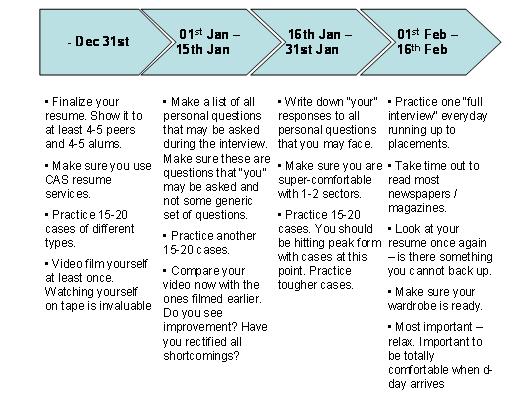
We are in mid-December and quite a few groups have started practising for interviews regularly. While every person will have a different schedule and a way of doing things - I thought it may be useful to lay out a general road map leading to placement season. This roadmap is specific to consulting and will not fit all interview prep - however it may not be a bad idea to have this for any sector that you may be targetting.
-- Rohit
Monday, December 12, 2005
Same start different endings - Useful Frameworks
This Sunday we had a marathon case prep session with Rohit conducting four consecutive interviews. The interesting part about this session was that each of the interviews started with the same problem statement but ended up with four completely distinct solutions.
Problem Statement: Market Share Problem
Our client is a world leading Pharma company. They have launched their blockbuster product - Human Insulin - in India. Although the product is extremely successful all over the world, it doesnt seem to be picking up steam in India. What can you do to help?
Analysis 1
Facts:
1. Doctors who were approached were very satisfied with the product and also recommended it willingly.
2. The stock was available at the drug store
3. C&F agents were satisfied
4. No incentive problem
5. Best medical reps were employed
6. Patients were happy with the product
7. Competitors were not posing a problem
8. Price was not an issue...
So.... what the hell was the problem? It turns out the problem was that this company had not employed sufficient number of sales reps and the distribution coverage was not sufficient.
Recommended Framework:
You could start off with a very broad framework - Internal vs. External forces. All outcomes are because of either some action taken by the company (internal forces) or because of some actions taken by the external entities (forces). Once you have isolated that there is nothing wrong with the external forces you should try enforcing a more specific framework. MarkStrat framework for market share is apt for this case. Market Share = Distribution Coverage x Purchase Intent x Awareness
You can quickly rule out Purchase Intent and Awareness by asking relevant questions. That leaves you with Distribution Coverage which is the right issue. It seems the company did not employ sufficient number of sales reps. So although those who were employed did a great job, not all doctors could be reached.
Aside:
You must ask questions regarding the value chain in this case. It turns out that in the Pharma sector the doctor is the key stakeholder in making or breaking a product. So unless a company has that front covered, it is in deep trouble.
Analysis 2
Facts
1. Everything else is fine
2. Prices are high and hence customers are not buying sufficient quantities.
3. Client knows this but isnt doing anything about it. WHY?????
4. The costs are low enough to permit a price cut.
5. No issue of global leadership not being sensitive to local needs.
So, whats the problem here?
Hint: Think about how a customer purchases a medicine. Think about India and also US, which is a major market for our client. How is the purchase paid for?
If you are thinking Insurance in the US context, you are bang on target! Okaie... Insurance so what? Think! Think!.....
You see, the company simply converts $ into INR and sells the product in India. So if it charges $1 in US then it charges INR 45 in India, although it could charge INR 20. The reason behind the company doing this is that, if it were to reduce the price of its product in India then the US Insurance companies would feel that they are being ripped-off by this company in the US and hence would sue it. So the company cant reduce the price of its product in India.
First Principles - Some useful questions to ask:
Once you know that the company is aware of the problem but isnt taking any corrective action, you should think about why is Indian market not that significant for the company? So asking some information about the contribution of Indian market to the over all sale might be a good question. Secondly, once you have been told about the insurance funda, its good to ask the implications of pricing it lower in the US as well.
Notice that this case cannot be cracked by using a framework. You need to think logically and start from first principles.
Analysis 3
Facts
1. Same as analysis 1, except that prices were high compared to competitors.
2. The company knows this but still wants to increase the market share without reducing price. How can it do so? Scratch... Scratch... Scratch...
Recommended Framework:
To cut a long story short, you can once again use the internal vs. external forces analysis to determine that there are two issues here - supply side and demand side. First of all, will the customers buy such a costly product? It turns out they would because our product is of an extremely high quality and is a life saving drug. So to convince the customer you should do an EVC and then sell on some softer issues such as importance of the customer's life to his/her family and long term benefit etc. For the supply side issue, you got to go through the entire value chain to determine where exactly the bottle neck is. It turns out that the drug store owners are not ready to stock the product because it means high working capital investment. So only way to resolve this is to offer higher credit. You can afford to do this because you are earning very high margins.
Once you have covered these two bases, you are thru!
Analysis 4
Facts:
1. All facts same as analysis 1
2. We have sufficient distribution coverage as well...
Now what?!
Recommended Framework:
Identify that the volumes sold depends on price, distribution coverage, segment size, purchase intent, awareness etc and rule them out quickly as likely suspects. Then you start looking for a bottleneck in the value chain. Turns out there is none!
So think think think....Then go to first principles and ask yourself where does all this demand come from? - you know its the doctors. If the doctors are responding favorably then the only issue could be that we are not targeting the right segment of doctors. It turns out that a huge proportion of Insulin sales arise out of family doctors/general practitioners. But intead of targeting these, our client is busy targeting the specialists, high profile doctors sitting in posh hospitals. Once you have got this... you are through :)
Long post, but it shows that there can be multiple endings to the same case. So stay alert!
-- Yash
Problem Statement: Market Share Problem
Our client is a world leading Pharma company. They have launched their blockbuster product - Human Insulin - in India. Although the product is extremely successful all over the world, it doesnt seem to be picking up steam in India. What can you do to help?
Analysis 1
Facts:
1. Doctors who were approached were very satisfied with the product and also recommended it willingly.
2. The stock was available at the drug store
3. C&F agents were satisfied
4. No incentive problem
5. Best medical reps were employed
6. Patients were happy with the product
7. Competitors were not posing a problem
8. Price was not an issue...
So.... what the hell was the problem? It turns out the problem was that this company had not employed sufficient number of sales reps and the distribution coverage was not sufficient.
Recommended Framework:
You could start off with a very broad framework - Internal vs. External forces. All outcomes are because of either some action taken by the company (internal forces) or because of some actions taken by the external entities (forces). Once you have isolated that there is nothing wrong with the external forces you should try enforcing a more specific framework. MarkStrat framework for market share is apt for this case. Market Share = Distribution Coverage x Purchase Intent x Awareness
You can quickly rule out Purchase Intent and Awareness by asking relevant questions. That leaves you with Distribution Coverage which is the right issue. It seems the company did not employ sufficient number of sales reps. So although those who were employed did a great job, not all doctors could be reached.
Aside:
You must ask questions regarding the value chain in this case. It turns out that in the Pharma sector the doctor is the key stakeholder in making or breaking a product. So unless a company has that front covered, it is in deep trouble.
Analysis 2
Facts
1. Everything else is fine
2. Prices are high and hence customers are not buying sufficient quantities.
3. Client knows this but isnt doing anything about it. WHY?????
4. The costs are low enough to permit a price cut.
5. No issue of global leadership not being sensitive to local needs.
So, whats the problem here?
Hint: Think about how a customer purchases a medicine. Think about India and also US, which is a major market for our client. How is the purchase paid for?
If you are thinking Insurance in the US context, you are bang on target! Okaie... Insurance so what? Think! Think!.....
You see, the company simply converts $ into INR and sells the product in India. So if it charges $1 in US then it charges INR 45 in India, although it could charge INR 20. The reason behind the company doing this is that, if it were to reduce the price of its product in India then the US Insurance companies would feel that they are being ripped-off by this company in the US and hence would sue it. So the company cant reduce the price of its product in India.
First Principles - Some useful questions to ask:
Once you know that the company is aware of the problem but isnt taking any corrective action, you should think about why is Indian market not that significant for the company? So asking some information about the contribution of Indian market to the over all sale might be a good question. Secondly, once you have been told about the insurance funda, its good to ask the implications of pricing it lower in the US as well.
Notice that this case cannot be cracked by using a framework. You need to think logically and start from first principles.
Analysis 3
Facts
1. Same as analysis 1, except that prices were high compared to competitors.
2. The company knows this but still wants to increase the market share without reducing price. How can it do so? Scratch... Scratch... Scratch...
Recommended Framework:
To cut a long story short, you can once again use the internal vs. external forces analysis to determine that there are two issues here - supply side and demand side. First of all, will the customers buy such a costly product? It turns out they would because our product is of an extremely high quality and is a life saving drug. So to convince the customer you should do an EVC and then sell on some softer issues such as importance of the customer's life to his/her family and long term benefit etc. For the supply side issue, you got to go through the entire value chain to determine where exactly the bottle neck is. It turns out that the drug store owners are not ready to stock the product because it means high working capital investment. So only way to resolve this is to offer higher credit. You can afford to do this because you are earning very high margins.
Once you have covered these two bases, you are thru!
Analysis 4
Facts:
1. All facts same as analysis 1
2. We have sufficient distribution coverage as well...
Now what?!
Recommended Framework:
Identify that the volumes sold depends on price, distribution coverage, segment size, purchase intent, awareness etc and rule them out quickly as likely suspects. Then you start looking for a bottleneck in the value chain. Turns out there is none!
So think think think....Then go to first principles and ask yourself where does all this demand come from? - you know its the doctors. If the doctors are responding favorably then the only issue could be that we are not targeting the right segment of doctors. It turns out that a huge proportion of Insulin sales arise out of family doctors/general practitioners. But intead of targeting these, our client is busy targeting the specialists, high profile doctors sitting in posh hospitals. Once you have got this... you are through :)
Long post, but it shows that there can be multiple endings to the same case. So stay alert!
-- Yash
Friday, December 09, 2005
Deep dive, stress testing and huge response
Generic CP:
Yesterday’s workout was a very good kick-off session for this year’s consulting preparation. The level of commitment shown by people who stand to derive no direct benefit from their effort is inspiring to say the least. Anant, our alum, had flown down from Delhi despite having worked the whole day and Gautam, who is a senior person at McK and not even an alum, wanted to be here but wasn’t able to make it due to some bizarre circumstances. In addition, Rohit also made it a point to be present for the entire session despite the fact he had just gotten his son back from the hospital. To top it all, we had a huge turnout and a deluge of entries! Hats-off guys! I hope that we are able to set some new records this year given our current energy levels.
Note:
There are several advantages to recording a case:
· it helps people analyze their performance and improve
· it helps people see other’s performance and either improve themselves or give constructive feedback to the concerned person
· it helps people track their progress through the prep season, and
· it will help the junior batch if we can pass on a library of even 10 top-notch case videos
We have also got some great feedback which we will try to incorporate in the next rounds.
REAL MEAT:
Below are some notes I took during yesterday’s workout session. I have jotted down some basic points about each case and the feedback given by the team as well as Anant and Rohit marked as "< rohit >".
Over All Takeaways:
o Define the problem.
o Take 30 secs to structure the problem.
o Identify buckets into which you can categorize the problem areas.
o Formulate some hypothesis.
o Then go about attacking one sliver after another.
o Ask if you are unsure.
o Finally synthesize by stating what the problem was, followed by what facts were stated, followed by which slivers were identified, followed by what analysis was done, and finally followed by the conclusion.
o Don’t try to fill silence with obvious questions.
o Structuring thoughts will help you avoid trivial questions.
o A good place to find out if the case is a quant / quali case is the problem statement. If there are lots of data points in the problem statement then you can guess that this is a quant case.
ROHIT C – RISHI V
Outline:
Wonder eye drop. Client has done R&D for 10 years. By using the eye drop for 10 days the user doesn’t need to use the spectacles ever. Competitor is 2 years behind in R&D. You have to market the product. How will you do it?
Team’s Comments:
· Interviewee was not initially sure about pricing.
· Interviewer did a good job.
Alum’s comments:
About Interviewee:
o Should have taken 30 seconds to organize your thoughts.
o Should have categorized your approach into three different buckets and then approached them separately.
o Appeared to be engaged in solving the problem.
o Body language was good – didn’t appear to be flustered, appeared to be driving hard towards a solution, lively interaction.
o Didn’t state hypothesis upfront, synthesize in the end.
o This was the problem, this is how we approached it, these were the facts and therefore this is our recommendation.
o Choice of language is important – make your language sound professional.
o Cases will be a mix of quali and quanti.
o Use a structure implicitly and not explicitly.
o Give a basis for your thinking.
SRIDHAR – SHANKAR --- ( awesome stress testing :D )
Case: ATM Public Sector Bank. Newly installed ATMs. No one is using them. How to increase ATM usage?
Team’s Comments:
Jot down the intermediate solutions. Helps in assimilating in the end.
Alum’s Comments:
Interviewee:
· Very good problem statement and then asked for a minute to think about it.
· Asking relevant questions but didn’t structure it upfront.
· Too much silence.
· It was good to ask ‘is there something I am missing?’
· Good body language. Seemed to want to solve the problem.
· Did not synthesize.
· Good creativity.
· The interviewer was able to confuse the candidate very easily. It would have helped to bucket the problem in multiple categories.
· Think through the process of issuing and using the card. Take a sliver and ask questions on that sliver. Ask for the process wrt to this particular branch.
· Ask questions about the industry average.
· Use the word hypothesis while stating your hypothesis.
· Introduce some quant questions from your side. Even if the quant is not relevant, asking about quant will indicate that you are comfortable with a quant.
· Ask questions about an industry that you are not aware about.
· If you miss out on some bucket in the analysis then introduce it later up front and state that you would like to include it in your analysis now.
TARUN’S CASE:
Pharma sector. New product. Two products with same functionality but different segments. Low market share. How to increase it?
Alum’s Comments:
Interviewee:
· Initial questions good. Did not follow up with time to structure the problem.
· Kept asking too many questions.
· Should have taken time out to build hypothesis.
· Never say ‘I have no idea’.
MANI’s CASE: (dude what was the problem statement? i forgot pls mail me)
Team’s comments (self analysis):
· Structure missing.
· Not addressing the questions directly.
· Candidate did not take the hints when the interviewer offered hints thrice.
· Did not ask for some key data points.
Alum’s comments:· Very serious feel to the case.
· The candidate should show resolve for problem solving, communication, rapport, creativity in getting at the solution.
Interviewer:
To be helpful to the candidate.
Interviewee:
o Ask for help if needed.
o Good to have clarified the question.
o Asked for too many facts.
o Essential to frame the problem statement in your words right at the onset.
o Structure was missing in the answers. Started shooting in the dark. There was no basis for asking some questions.
o Summarize the approach right away and take the interviewer’s view.
o Asked for too much time. Be ready with a quick and dirty answer.
o You didn’t appear to be interested in solving the problem à lack of enthusiasm and interest in solving the problem.
o Make it very interactive. Get the interviewer to talk more.
o Summarize your findings.
o End the interview on a good note.
o Writing for too long a time and therefore loss of eye contact.
o State a hypothesis upfront à this is where I am going, this is the direction in which I think the solution lies “I think it’s a distribution problem and here are my reasons and here are the questions I want clarified so that I can solve the case.”
o Don’t state the solution upfront. Just state the options that you want to explore
Final Questions and Answers:
o Should a wild card question be asked, such as “should I know something more about the case”?
It is a fair thing to ask, because as a consultant you can ask this question to your client.
o How do you start seeing improvement?
You will see improvement within two weeks. Start structuring your problems and you will see improvement. Be regular. Always get someone to ask you questions and some people to observe. It’s a good idea to start with Vault and Wetfeet frameworks. But don’t try to force fit some framework.
o You need to be comfortable with the sector from which you have come from. You need to be comfortable with at least two sectors.
-- Yash
Yesterday’s workout was a very good kick-off session for this year’s consulting preparation. The level of commitment shown by people who stand to derive no direct benefit from their effort is inspiring to say the least. Anant, our alum, had flown down from Delhi despite having worked the whole day and Gautam, who is a senior person at McK and not even an alum, wanted to be here but wasn’t able to make it due to some bizarre circumstances. In addition, Rohit also made it a point to be present for the entire session despite the fact he had just gotten his son back from the hospital. To top it all, we had a huge turnout and a deluge of entries! Hats-off guys! I hope that we are able to set some new records this year given our current energy levels.
Note:
There are several advantages to recording a case:
· it helps people analyze their performance and improve
· it helps people see other’s performance and either improve themselves or give constructive feedback to the concerned person
· it helps people track their progress through the prep season, and
· it will help the junior batch if we can pass on a library of even 10 top-notch case videos
We have also got some great feedback which we will try to incorporate in the next rounds.
REAL MEAT:
Below are some notes I took during yesterday’s workout session. I have jotted down some basic points about each case and the feedback given by the team as well as Anant and Rohit marked as "< rohit >".
Over All Takeaways:
o Define the problem.
o Take 30 secs to structure the problem.
o Identify buckets into which you can categorize the problem areas.
o Formulate some hypothesis.
o Then go about attacking one sliver after another.
o Ask if you are unsure.
o Finally synthesize by stating what the problem was, followed by what facts were stated, followed by which slivers were identified, followed by what analysis was done, and finally followed by the conclusion.
o Don’t try to fill silence with obvious questions.
o Structuring thoughts will help you avoid trivial questions.
o A good place to find out if the case is a quant / quali case is the problem statement. If there are lots of data points in the problem statement then you can guess that this is a quant case.
ROHIT C – RISHI V
Outline:
Wonder eye drop. Client has done R&D for 10 years. By using the eye drop for 10 days the user doesn’t need to use the spectacles ever. Competitor is 2 years behind in R&D. You have to market the product. How will you do it?
Team’s Comments:
· Interviewee was not initially sure about pricing.
· Interviewer did a good job.
Alum’s comments:
About Interviewee:
o Should have taken 30 seconds to organize your thoughts.
o Should have categorized your approach into three different buckets and then approached them separately.
o Appeared to be engaged in solving the problem.
o Body language was good – didn’t appear to be flustered, appeared to be driving hard towards a solution, lively interaction.
o Didn’t state hypothesis upfront, synthesize in the end.
o This was the problem, this is how we approached it, these were the facts and therefore this is our recommendation.
o Choice of language is important – make your language sound professional.
o Cases will be a mix of quali and quanti.
o Use a structure implicitly and not explicitly.
o Give a basis for your thinking.
SRIDHAR – SHANKAR --- ( awesome stress testing :D )
Case: ATM Public Sector Bank. Newly installed ATMs. No one is using them. How to increase ATM usage?
Team’s Comments:
Jot down the intermediate solutions. Helps in assimilating in the end.
Alum’s Comments:
Interviewee:
· Very good problem statement and then asked for a minute to think about it.
· Asking relevant questions but didn’t structure it upfront.
· Too much silence.
· It was good to ask ‘is there something I am missing?’
· Good body language. Seemed to want to solve the problem.
· Did not synthesize.
· Good creativity.
· The interviewer was able to confuse the candidate very easily. It would have helped to bucket the problem in multiple categories.
· Think through the process of issuing and using the card. Take a sliver and ask questions on that sliver. Ask for the process wrt to this particular branch.
· Ask questions about the industry average.
· Use the word hypothesis while stating your hypothesis.
· Introduce some quant questions from your side. Even if the quant is not relevant, asking about quant will indicate that you are comfortable with a quant.
· Ask questions about an industry that you are not aware about.
· If you miss out on some bucket in the analysis then introduce it later up front and state that you would like to include it in your analysis now.
TARUN’S CASE:
Pharma sector. New product. Two products with same functionality but different segments. Low market share. How to increase it?
Alum’s Comments:
Interviewee:
· Initial questions good. Did not follow up with time to structure the problem.
· Kept asking too many questions.
· Should have taken time out to build hypothesis.
· Never say ‘I have no idea’.
MANI’s CASE: (dude what was the problem statement? i forgot pls mail me)
Team’s comments (self analysis):
· Structure missing.
· Not addressing the questions directly.
· Candidate did not take the hints when the interviewer offered hints thrice.
· Did not ask for some key data points.
Alum’s comments:· Very serious feel to the case.
· The candidate should show resolve for problem solving, communication, rapport, creativity in getting at the solution.
Interviewer:
To be helpful to the candidate.
Interviewee:
o Ask for help if needed.
o Good to have clarified the question.
o Asked for too many facts.
o Essential to frame the problem statement in your words right at the onset.
o Structure was missing in the answers. Started shooting in the dark. There was no basis for asking some questions.
o Summarize the approach right away and take the interviewer’s view.
o Asked for too much time. Be ready with a quick and dirty answer.
o You didn’t appear to be interested in solving the problem à lack of enthusiasm and interest in solving the problem.
o Make it very interactive. Get the interviewer to talk more.
o Summarize your findings.
o End the interview on a good note.
o Writing for too long a time and therefore loss of eye contact.
o State a hypothesis upfront à this is where I am going, this is the direction in which I think the solution lies “I think it’s a distribution problem and here are my reasons and here are the questions I want clarified so that I can solve the case.”
o Don’t state the solution upfront. Just state the options that you want to explore
Final Questions and Answers:
o Should a wild card question be asked, such as “should I know something more about the case”?
It is a fair thing to ask, because as a consultant you can ask this question to your client.
o How do you start seeing improvement?
You will see improvement within two weeks. Start structuring your problems and you will see improvement. Be regular. Always get someone to ask you questions and some people to observe. It’s a good idea to start with Vault and Wetfeet frameworks. But don’t try to force fit some framework.
o You need to be comfortable with the sector from which you have come from. You need to be comfortable with at least two sectors.
-- Yash
Tuesday, December 06, 2005
Case: Bank's modernization strategy
Interviewer: Umang
Interviewee: Yash
Nature of case: 90% quali - 10% quant ( :) once again...quali case)
Problem Statement: A bank wants to close down its eight branches and move all operations online. Should it do so? How would it go about making the decision?
I am not going to reproduce the interview here, but I will mention my key takeaways.
This time I tried to put some structure to my thoughts... :)
Started off by listing the implications the move could have:
1. Impact on Profit
1.1 Due to loss of revenue due to loss of customers
1.2 Due to increase in revenue due to gain of customers
1.3 Due to increase in costs on account of taking all transactions online
1.4 Due to cost savings from closing old operations
2. Impact on Goodwill due to loss of customers (if any)
3. Is this move aligned with the over all strategy and image of the bank?
4. What other benefits could this move entail (I didnt think of this point but I think this should be considered)?
With this thought clear in my mind, i went about asking relevant questions.
Firstly, i wanted to understand the customer profile across branches and whether or not they would migrate willingly onto the new platform. I was informed that the young : old customer ratio is 1:1 which was consistent across the branches. Then i surmised that the old customers must be high net worth customers and hence more profitable for our branch. They might also be ones not very eager to move online. Some of the younger customers might be relatives (sons - daughters) of these old customers. If the family wants to bank with one bank, then some of the young customers might also move along with the old customers if the aged customers decide to move their account elsewhere.
All these points were validated by Umang to be true.
With all this in mind, i recommended that firstly we should do some customer survey to get some feedback about the viability of this plan. Then we should pilot this program in some branches to evaluate the response.
Next, I asked a lot of quant questions about the per transaction cost, profit, expected customer base, expected loss of customers etc ... but this being a quali case, I couldnt get much out of Umang and spent a lot of time just groping in the dark without much data :)
In the process I missed out on asking questions regarding the new services that would be offered, which was pointed out by Umang. Again, this led to some qualitative discussion with no quant stuff available.
Finally, Umang asked me to express the decision in a single equation.
Take Aways: 1. I didnt explicitly link recommendation to reasoning.
2. Final conclusion was not very assertive. I should have said, "because of points a, b, c, d, and e, I recommend xyz." I didnt do it. The interview closed with a casual feel... not good enough.
3. It helped a lot to ask for two mins time to organize my thoughts right at the beginning of the interview after understanding the problem clearly.
Cheers!
Yash
Interviewee: Yash
Nature of case: 90% quali - 10% quant ( :) once again...quali case)
Problem Statement: A bank wants to close down its eight branches and move all operations online. Should it do so? How would it go about making the decision?
I am not going to reproduce the interview here, but I will mention my key takeaways.
This time I tried to put some structure to my thoughts... :)
Started off by listing the implications the move could have:
1. Impact on Profit
1.1 Due to loss of revenue due to loss of customers
1.2 Due to increase in revenue due to gain of customers
1.3 Due to increase in costs on account of taking all transactions online
1.4 Due to cost savings from closing old operations
2. Impact on Goodwill due to loss of customers (if any)
3. Is this move aligned with the over all strategy and image of the bank?
4. What other benefits could this move entail (I didnt think of this point but I think this should be considered)?
With this thought clear in my mind, i went about asking relevant questions.
Firstly, i wanted to understand the customer profile across branches and whether or not they would migrate willingly onto the new platform. I was informed that the young : old customer ratio is 1:1 which was consistent across the branches. Then i surmised that the old customers must be high net worth customers and hence more profitable for our branch. They might also be ones not very eager to move online. Some of the younger customers might be relatives (sons - daughters) of these old customers. If the family wants to bank with one bank, then some of the young customers might also move along with the old customers if the aged customers decide to move their account elsewhere.
All these points were validated by Umang to be true.
With all this in mind, i recommended that firstly we should do some customer survey to get some feedback about the viability of this plan. Then we should pilot this program in some branches to evaluate the response.
Next, I asked a lot of quant questions about the per transaction cost, profit, expected customer base, expected loss of customers etc ... but this being a quali case, I couldnt get much out of Umang and spent a lot of time just groping in the dark without much data :)
In the process I missed out on asking questions regarding the new services that would be offered, which was pointed out by Umang. Again, this led to some qualitative discussion with no quant stuff available.
Finally, Umang asked me to express the decision in a single equation.
Take Aways: 1. I didnt explicitly link recommendation to reasoning.
2. Final conclusion was not very assertive. I should have said, "because of points a, b, c, d, and e, I recommend xyz." I didnt do it. The interview closed with a casual feel... not good enough.
3. It helped a lot to ask for two mins time to organize my thoughts right at the beginning of the interview after understanding the problem clearly.
Cheers!
Yash
Sunday, December 04, 2005
Guide for Case Preps
Here is an important document which talks about Case Interview preparation.
I have posted the link of the doc on general home. Click
Here ...
-- Yash
I have posted the link of the doc on general home. Click
Here ...
-- Yash
Saturday, December 03, 2005
The "X" Factor
Great to see that Yash has taken this initiative to start a collaborative blog to help students prepare for consulting interviews.
I was thinking as to what should I write in my first post. I think the "X" factor is an interesting topic to write on. So what does "X" factor mean? Essentially in the consulting context this has two dimensions -
first is the personality of the person being interviewed.
second is how has the person carries himself in the interview.
The first one is important because recruiters often ask the question - "Can I work with this person as part of a two member team in a remote location for six months?" The answer to this question is critically important and often decides whether a firm wants to hire the person or not. Having said this you cannot become a "fun" person overnight if you are essentially an introvert or do not like too many social interactions. So this part of the "X" factor is difficult to control and work on ....
The second one is how one dresses and carries himself when he is being interviewed. This variable is completely in our control. The points given below are specific to consulting interviews and may not hold true for a "IT services company" interview....every sector has its own requirements
- Make sure you have the right suit on. Borrowing your quaddies jacket is definitely a no no !! A black suit stiched to your requirements is the safest bet as far as consulting interviews go ... Blazers purchased off the shelf normally are not a good idea.
- A white shirt is again a safe bet..a double cuff shirt with classy cuff-links really goes well with a black suit..Also as far as shirt goes it makes sense to purchase a brand new one just before the interview season. Old white shirts beaten to death by the laundry guy are not ideal
- A plain tie or a striped tie goes well with a black suit and a white shirt. Mickey mouse motifs on the tie are not ideal for a consulting interview !!
- A black shoe should be combined with a black belt. The biggest goof up is a black shoe with a brown belt or vice versa...
- Those who wear specs may want to get brand new ones made - the type you see the "consulting types" wearing ...rimless with anti-reflection lenses et al
What does the above mean ?? Style is no substitute for substance - none of this will get you through a consulting interview. But does it matter - the answer is a resounding yes !! The people who come down to recruit also evaluate as to whether they can put you in front of the client on day 1 - having the right appearance helps...
So while you practice the case interviews and tear the wetfeet and vault guides apart, make sure you make the trip to the Raymonds showroom and are ready when the d-day comes...
The "X" factor counts ....
- Rohit
First Blood
None of us except Rohit had any idea about what exactly a case interview is! Watching BCG dudes perform a mock interview is one thing but actually doing it yourself is a totally different game. So Rohit took up the responsibility to flag off the grand prix.
Case 1 - Correcting a strategic implementation gone sour
Interviewer - Rohit
Interviewee - your truly
R: One of the biggest public sector banks in India is our client. Some time ago it decided to install ATMs across thousands of its branches across India. Its been a long time since then but no one seems to use those ATMs. What should they do?
Y: After jotting down some key points - largest bank, public sector, India, large number of branches etc... So if i understand the problem correctly, this bank has installed ATMs in a lot of branches but there arent sufficient number of transactions being generated. Assuming that the bank make some money per transaction, the problem is that it has done a large Capex but is not able to recover any of it. Am I correct ?
R: No. The bank just wants to offer its customers more convenience, not make money from the ATMs.
Y: Ok... after a lot of questions and answers... So whats the profile of these customers - young/old, wealthy/middle class/poor?
R: they are mostly middle aged to old pensioners.
Y: So may be these people are not tech savvy. Were they given sufficient user training?
R: Yeah that was problem. They werent given much training earlier but now this bank has posted a person near each ATM.
Y: lots of questions like - is the ATM prominently located, is it user friendly, has the number of transactions over the counter reduced or is it the same ... etc etc etc... basically going no where.
R: Think about the process of using an ATM.
Y: Bingo!... do all of the customers have cards?
R: Well actually no... we havent been able to send out cards to all our customers. Its a costly process etc...
Y: Ok, so this bank should profile the customers who come most often for a cash transaction and use the technology used by ICICI. Have pre-printed cards for these customers and give them to these customers when they come to the branch.
R:... some more discussion about the exact process of doing this. Problems with pre-printed cards etc. Finally, R says cut - time out.
Feedback from Ankur, Umang and Rohit. Final takeaways:
1. This interview will take me to next round but they will test me again. So this is neither a direct-in, nor a direct-out case.
2. I should have asked some quant questions like - what exactly do you mean by transactions have tapered off? Whats the industry average? Whats this bank's average?
3. This was a 80 - quali ; 20 - quant case.
4. Structure was conspicuous by its absence. Need to structure the analysis better...
5. Recommendations should be more thoughtful backed up by reasons and assumptions.
6. Make the interview into more of a conversation.
7. It was good that I picked up the hint when it was offered. Had i missed it, it would have been all over for me.
8. Should not mumble ... think out aloud after letting the interviewer know that you are doing so.
9. Indicate that you are about to jot down some points and then start writing. Otherwise you lose eye-contact and the interviewer doesnt know what to do.
Case 2 was with Umang... more on that later - may be Umang can post it himself.
Others are welcome to post their experiences as well.
Let me know your comments and feedback.
--Yash
Case 1 - Correcting a strategic implementation gone sour
Interviewer - Rohit
Interviewee - your truly
R: One of the biggest public sector banks in India is our client. Some time ago it decided to install ATMs across thousands of its branches across India. Its been a long time since then but no one seems to use those ATMs. What should they do?
Y: After jotting down some key points - largest bank, public sector, India, large number of branches etc... So if i understand the problem correctly, this bank has installed ATMs in a lot of branches but there arent sufficient number of transactions being generated. Assuming that the bank make some money per transaction, the problem is that it has done a large Capex but is not able to recover any of it. Am I correct ?
R: No. The bank just wants to offer its customers more convenience, not make money from the ATMs.
Y: Ok... after a lot of questions and answers... So whats the profile of these customers - young/old, wealthy/middle class/poor?
R: they are mostly middle aged to old pensioners.
Y: So may be these people are not tech savvy. Were they given sufficient user training?
R: Yeah that was problem. They werent given much training earlier but now this bank has posted a person near each ATM.
Y: lots of questions like - is the ATM prominently located, is it user friendly, has the number of transactions over the counter reduced or is it the same ... etc etc etc... basically going no where.
R: Think about the process of using an ATM.
Y: Bingo!... do all of the customers have cards?
R: Well actually no... we havent been able to send out cards to all our customers. Its a costly process etc...
Y: Ok, so this bank should profile the customers who come most often for a cash transaction and use the technology used by ICICI. Have pre-printed cards for these customers and give them to these customers when they come to the branch.
R:... some more discussion about the exact process of doing this. Problems with pre-printed cards etc. Finally, R says cut - time out.
Feedback from Ankur, Umang and Rohit. Final takeaways:
1. This interview will take me to next round but they will test me again. So this is neither a direct-in, nor a direct-out case.
2. I should have asked some quant questions like - what exactly do you mean by transactions have tapered off? Whats the industry average? Whats this bank's average?
3. This was a 80 - quali ; 20 - quant case.
4. Structure was conspicuous by its absence. Need to structure the analysis better...
5. Recommendations should be more thoughtful backed up by reasons and assumptions.
6. Make the interview into more of a conversation.
7. It was good that I picked up the hint when it was offered. Had i missed it, it would have been all over for me.
8. Should not mumble ... think out aloud after letting the interviewer know that you are doing so.
9. Indicate that you are about to jot down some points and then start writing. Otherwise you lose eye-contact and the interviewer doesnt know what to do.
Case 2 was with Umang... more on that later - may be Umang can post it himself.
Others are welcome to post their experiences as well.
Let me know your comments and feedback.
--Yash
Welcome to Consulting @ ISB
Hello everyone and welcome to the consulting blog. The purpose of this blog is to keep everyone current on the progress various teams have been making in their journey towards the coveted 'big-ticket' consulting firm. This blog is meant to be a collaborative effort. Interested people - please contact me (yashraj_erande@pgp2006.isb.edu).
The main aim of this blog is to work as a platform for sharing experiences and exchanging notes as we progress through our interview and case prep sessions.
You are welcome to post comments, links to informative websites or any thing that you believe will be useful in the pursuit for a job with "the dream firm".
Please do post your comments and feedback.
In my next post, I will discuss my takeaways from my first case prep session with my team - Rohit Kapoor, Umang, and Ankur. Cya soon !
Cheers! - Yash
The main aim of this blog is to work as a platform for sharing experiences and exchanging notes as we progress through our interview and case prep sessions.
You are welcome to post comments, links to informative websites or any thing that you believe will be useful in the pursuit for a job with "the dream firm".
Please do post your comments and feedback.
In my next post, I will discuss my takeaways from my first case prep session with my team - Rohit Kapoor, Umang, and Ankur. Cya soon !
Cheers! - Yash
Subscribe to:
Posts (Atom)
